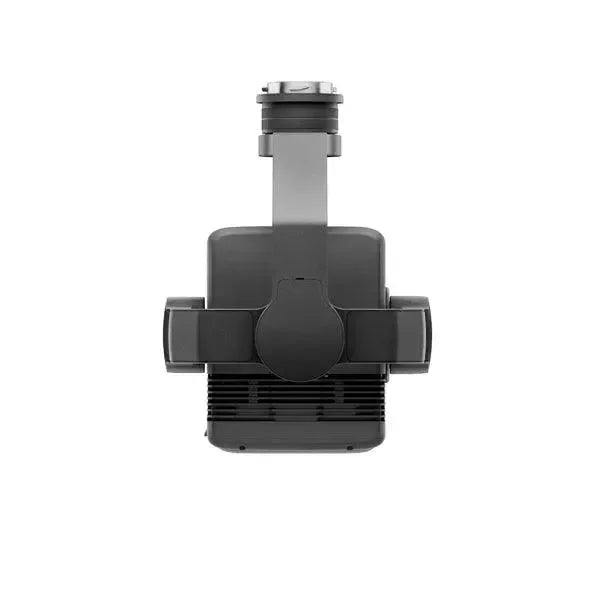
Integrated LiDAR solution

Backed by its powerful hardware, the L2 can enable precise scanning of complex subjects within an extended range and faster point cloud acquisition. During operations, users can preview, playback, and process point cloud models on-site, with job quality reports generated by DJI Terra, offering a simple and comprehensive solution for improving overall efficiency. This allows users to achieve high-precision point cloud results with unique post-processing.
High level precision
By combining GNSS and a high-precision IMU developed in-house, this solution achieves a vertical accuracy of 4 cm and a horizontal accuracy of 5 cm. 1
Exceptional efficiency
It is ready to operate as soon as it is turned on and can collect both geospatial and RGB data from an area of 2.5 square kilometers in a single flight. 2
Intuitive operation
When combined with the Matrice 350 RTK and DJI Terra, L2 offers an easy-to-use turnkey solution, lowering the operational threshold.
Frame-based LiDAR

Increased detection range by 30% 5
The L2 can detect from 250 meters at 10% reflectivity and 100 klx, 3 and up to 450 meters at 50% reflectivity and 0 klx. 3 The typical operating altitude now extends up to 120 meters, greatly improving safety and operational efficiency.
Smaller laser points, denser point clouds
With a smaller spot size of 4×12 cm at 100 m, just one-fifth that of the L1, the L2 not only detects smaller objects in more detail, but can also penetrate denser vegetation, generating more accurate digital elevation models (DEMs).
Supports 5 returns
In densely vegetated areas, L2 can capture more ground points under foliage.
Effective point cloud speed: 240,000 points/s
In both single and multiple return modes, the L2 can reach a maximum point cloud output rate of 240,000 points per second, allowing for the acquisition of more point cloud data in a given time interval.
Two scanning modes
The L2 supports two scanning modes, offering users flexibility based on their task needs. In repetitive scanning mode, the L2 LiDAR can obtain more uniform and precise point clouds, while meeting high-precision mapping requirements. In non-repetitive scanning mode, it offers deeper penetration for greater structural information, making it suitable for power line inspection, forestry surveying, and other scenarios.
Frame-based design
The frame-based design ensures up to 100% effective point cloud data rate. Combined with a three-axis gimbal, it offers greater scenario detection capabilities.
High precision IMU system

Improved accuracy
The self-developed, high-precision IMU system, combined with the drone's RTK positioning system for data fusion during post-processing, provides L2 with access to highly accurate information on absolute position, velocity, and attitude. Furthermore, the IMU system's greater environmental adaptability improves L2's operational reliability and accuracy.
Yaw accuracy 6
Real-time: 0.2°, post-processing: 0.05°
Pitch/Roll Accuracy 6
Real-time 0.05°, post-processing 0.025°
No IMU heating
The IMU system's performance has been significantly improved and is ready for use the moment it's powered on. Additionally, the companion drone is ready to begin operations immediately once the RTK is in FIX mode, providing an optimized field experience.
RGB Mapping Camera
4/3 CMOS, mechanical shutter
The pixel size has been expanded to 3.3 μm, and the effective pixels now reach 20 MP, resulting in a significant improvement in the overall image and richer true-color point cloud detail. The minimum interval between photos has been reduced to 0.7 seconds. The mapping camera can count on up to 200,000 shutter cycles, further reducing operating costs. When point cloud collection is not needed, the RGB camera can still take photos and videos or collect images for visible light mapping.
Improved operating experience

Diversified flight
Route types
It supports waypoint, area and linear path types, to handle surveying tasks in a variety of environments.
Point cloud
Live
During operation, DJI Pilot 2 supports three display modes: RGB, point cloud, and point cloud/RGB side-by-side display, presenting operational results intuitively. Activating the RNG (Laser Rangefinder) provides access to distance information between the LiDAR module and the object at the center of the FOV, improving flight safety. It also supports four real-time point cloud coloring modes: Reflectivity, Height, Distance, and RGB.
Point cloud model
Reproduction and fusion
After the operation, the 3D point cloud model 7 can be viewed directly in the album. 3D point cloud models from multiple flights can also be merged, enabling on-site decision-making regarding operational quality.
Automatically generated activity
Quality Report
After collecting point cloud data, the DJI Pilot 2 app will automatically generate a Job Quality Report 8 so operators can check operational results in real time and on-site, making field work more responsive and worry-free.
PPK
Solution
It supports waypoint, area and linear path types, to handle surveying tasks in a variety of environments.
One-click processing
on DJI Terra
Get efficient and reliable one-stop post-processing when importing point cloud data into DJI Terra. Generate a 3D point cloud model in a standard format with a single click after calculating the point cloud trajectory and optimizing accuracy. After ground point classification, using the ground point type, you can generate a DEM. Point cloud quality can be analyzed with the Accuracy Check and Verification function.
Application scenarios 
In coordination with the DJI Enterprise and DJI Terra flight platforms, the Zenmuse L2 can be applied to land surveying and mapping, electricity, forestry, and infrastructure management, as well as other scenarios.
Notes
1. Measured under the following conditions in a DJI laboratory environment: The Zenmuse L2 mounted on a Matrice 350 RTK and powered on. Using DJI Pilot 2's overhead route to plan the flight path (with Calibrate IMU enabled). Using repetitive scanning with RTK in FIX mode. Relative altitude was set to 150 m, flight speed to 15 m/s, gimbal pitch to -90°, and each straight segment of the flight path was less than 1500 m. The field contained objects with obvious angular features and used exposed hard ground control points conforming to the diffuse reflection model. DJI Terra was used for post-processing with point cloud accuracy optimization enabled. Under the same conditions with Optimize Point Cloud Accuracy disabled, the vertical accuracy is 4 cm and the horizontal accuracy is 8 cm.
2. Measured with the Zenmuse L2 mounted on a Matrice 350 RTK with a flight speed of 15 m/s, flight altitude of 150 m, lateral overlap rate of 20%, IMU calibration enabled, elevation optimization disabled, and terrain tracking disabled.
3. The data presented are typical values. Measured using a flat target larger than the laser beam diameter, a perpendicular angle of incidence, and an atmospheric visibility of 23 km. In low-light environments, laser beams can achieve optimal detection range. If a laser beam hits more than one target, the total power of the laser transmitter is divided and the achievable range is reduced. The maximum detection range is 500 m.
4. After powering on, the IMU does not require warm-up; however, users must wait until the RTK drone is in the FIX state before it can fly and operate.
5. Calculated by comparing with Zenmuse L1.
6. Measured under the following conditions in a DJI laboratory environment: Zenmuse L2 mounted on a Matrice 350 RTK and powered on. Using DJI Pilot 2's overhead route to plan the flight path (with Calibrate IMU enabled). RTK in FIX state. Relative altitude was set to 150 m, flight speed to 15 m/s, gimbal pitch to -90°, and each straight segment of the flight path was less than 1500 m.
7. 3D models are processed using sparse representation.
8. Only supports generating quality reports for waypoints, areas, and linear activities.