

DJI Mini 5 Pro vs DJI Mini 4 Pro: the main differences
When a new model joins a successful product line like the DJI Mini Pro drones, the temptation to upgrade is inevitable. Everyone, of course, has their own specific needs, but when it comes to numbers , performance , substantial news , well, the portable drone DJI Mini 5 Pro It certainly can't be out of place. In the following paragraphs, we describe the main Differences between the Mini 5 Pro and the Mini 4 Pro from last year.
The obstacle detection relies on an omni-directional binocular vision system, integrated with a LiDAR front sensor and an infrared sensor on the underside of the aircraft.
Video transmission system: O4+
Focal length: 24mm (equivalent)
FOV (field of view): 84°
Opening: f/1.8
Focus distance: from 0.5 m to ∞

The obstacle detection It relies on an omni-directional binocular vision system, integrated with a 3D infrared sensor on the underside of the aircraft.
Video transmission system: O4
Focal length: 24mm (equivalent)
FOV (field of view): 82.1°
Opening: f/1.7
Focus distance: from 1 but ∞
DJI Mini 5 Pro: A large sensor for great photos and videos
DJI, with its new drone, pushes the limits of what can be achieved while remaining under the fateful weight of 250 grams , but the most obvious leap forward is in the camera.
The DJI Mini 4 Pro It mounts a 1/1.3″ 48 MP sensor with f/1.7 aperture, while the Mini 5 Pro It switches to a 1″ 50MP with an f/1.8 aperture. This may seem like a numerical shift of insignificant decimal points, but it is not. The sensitive area almost doubles , with concrete effects on dynamic range And low-light performance , while maintaining its “ultralight” vocation. The higher resolution of the Mini 5 Pro’s sensor translates into slightly larger images: 8192×6144 pixels versus 8064×6048 pixels (of the Mini 4 Pro).
Even in the video formats The Mini 5 Pro clearly dominates. The DJI Mini 4 Pro reaches 4K (3,840×2,160 pixels) at up to 60 frames per second (60 fps), with 4K/120 fps slow-motion and Full HD (1920×1080 pixels) at up to 200 fps.
The DJI Mini 5 Pro pushes slow-motion to 4K/120 fps and Full HD/240 fps, as well as offering 10-bit recording in HLG And D-Log M , like the 4 Pro. In practice: for those who shoot a lot in 4K and love clear slow-motion, the DJI Mini 5 Pro is much more flexible.
The photographic “inclinations” of the Mini 5 Pro
Let's now move on to the front of the stabilization and vertical framing . Both models mount a 3-axis mechanical gimbal (tilt, roll and horizontal rotation) and provide “ True Vertical Shooting ”. There is one difference, however, and it is in the mechanical travel.
The Mini 5 Pro extends the roll (up to −230°/+95° mechanical range, −180°/+45° controllable range) compared to the Mini 4 Pro (up to -135°/+45° mechanical range, -90°/0° controllable).
In practice, the Mini 4 Pro It allowed a slight lateral tilt of the camera, to keep the horizon straight or with small corrections.
The Mini 5 Pro can tilt much more , almost to the point of “flipping” sideways, thus opening the way to more creative shots such as complete rotations of the scene , special transitions , broader corrections in post-production.
Flying safely with forward-facing Lidar
Flight safety takes a truly significant step forward. DJI Mini 4 Pro adopts a built-in omnidirectional binocular vision system with a downward-facing infrared sensor, which is already extremely effective for a product of this kind. With the DJI Mini 5 Pro, we've gone one step further by adding a front-facing LiDAR that works alongside omnidirectional binocular vision and an additional lower IR . Learn more: LiDAR Technology: Portrait of DJI Drones’ Trusty Companion – Part 1/2 .
The practical advantage, especially at dusk and in scenarios that can produce confusion, is more reliable distance estimation and much more complete obstacle avoidance.
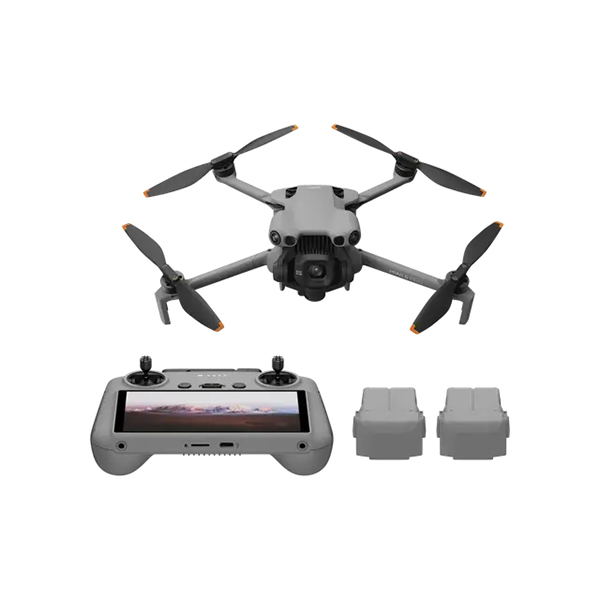
(with DJI RC2 remote control)
Package Contents
- DJI Mini 5 Pro
- DJI RC 2 remote control
- ND filter set (ND8/ND32/ND128)
- smart rechargeable battery
- storage harness
- 3x pairs of spare propellers
- semi-rigid case
- USB-C cable
O4+ and O4: transmissions without uncertainties
Transmission and controls chapter: The Mini 4 Pro uses the transmission system O4 (Live View up to 1080p and 60 fps) with a maximum declared range of 20 km FCC and 10 km CE. The DJI Mini 5 Pro introduces O4+ (Live View 1080p at 30/60 fps) and maintains the same nominal maximum distances (20 km according to the US authority, F CC , 10 km according to European standards, CE) but updates the so-called radio stack and download management (Wi-Fi 6 up to 100 MB/s for transfer to device).
In real-world scenarios, the difference translates more into stability and handover speed than into additional “kilometers.” This means that it is easier to change frequency or band to maintain a stable connection with the remote control when the environment is congested or disturbed.

DJI Mini 5 Pro: Fly a little further
Battery life also improves: from 34 minutes maximums on the Mini 4 Pro (standard battery) at 36 minutes on the Mini 5 Pro. With the “Plus” batteries the values rise to 45 and 52 minutes respectively, but in Europe the Plus batteries are not marketed for these categories of drones (which would exceed the 250 gram limit in weight).
We also offer a "typical time," an estimate based on the most common environmental conditions and video recording: approximately 21 minutes with 4K/60 fps recording and wind, useful for planning missions. This is an often overlooked detail: the internal memory . The DJI Mini 4 Pro delivers 2 GB , just for emergencies, but the DJI Mini 5 Pro brings the storage to a whopping 42 GB , enough for short sessions even without a microSD memory card.
Between wind and cold, always at ease
As for wind resistance and operability, The Mini 5 Pro is rated at up to 12 m/s versus the Mini 4 Pro's 10.7 m/s . Both, however, operate from -10 °C to 40 °C and support GPS + Galileo + BeiDou . In essence, the new model offers an extra margin when the weather worsens .
In terms of user experience, experts and enthusiasts are confirming the concrete impact of the innovations The Mini 5 Pro's 1" sensor improves performance and flexibility. Slow-motion is generated from videos captured at 4K/120 fps extends the narrative options , while the combination LiDAR + omnidirectional vision It makes it harder to have unpleasant crashes, especially in low light. In short, there are quite a few reasons for an update. Can we tell you? You won't find another mini drone that packs so much technology without weighing over 250g .

 https://www.instagram.com/3digital.tech/

